



08 Sep They Put Braces on Dogs’ Teeth???
That’s right- braces aren’t just for kids! The term “orthodontics” refers to the practice of restoring teeth to a normal alignment. Having your teeth in the right place can alleviate crowding that predisposes teeth to periodontal disease. The location of your teeth can also affect your speech, how you feel about your appearance, and interactions with other people. When we treat crooked teeth in a dog or cat, we are primarily concerned with alleviating pain because every pet deserves to have a comfortable mouth!
Malocclusion in Dogs
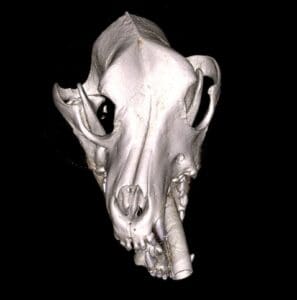
CBCT 3D reconstruction of a dog with a severe malocclusion secondary to earlier trauma
Malocclusion is the term used to describe the misalignment of teeth. Sometimes this is because the teeth are in the wrong position (dental malocclusion). Sometimes it is because of a discrepancy in jaw length (skeletal malocclusion). Causes for malocclusion are not always clear. Sometimes it can be hereditary such as “lance canines” in Shelties. The gene for this malocclusion has been identified and is associated with small body size in this breed.1 Trauma at a young age can also displace a tooth or decrease the growth of the jaw bones.
Linguoverted Canines
The most common dental malocclusion seen at our practice is called linguoverted canines or more commonly, “base narrow canines”. In this malocclusion, the lower canine teeth of a dog are upright instead of tilting outwards to sit on the outside of the upper jaw. These upright canines end up contacting the roof of the mouth. Sometimes only one tooth is affected and other times both teeth are affected.
Treating Base Narrow Canines in Puppy Teeth
Have you ever had a puppy chew on your hand? Then you know how sharp those baby canine teeth are! Base narrow baby canines can puncture the soft tissue of the palate causing pain and infection. Puppies with this condition will still eat and play, leading owners to think that there aren’t any problems. Remember that the puppy was born that way and does not know what it’s like not to hurt. The recommended treatment is to extract the baby canines to alleviate pain. A recent study evaluated the effect of extraction on the position of the adult teeth2. Extracting problem baby teeth is called interceptive orthodontics because it can help prevent malocclusion of the adult teeth.
Base Narrow Canine Treatment in Adult Dogs
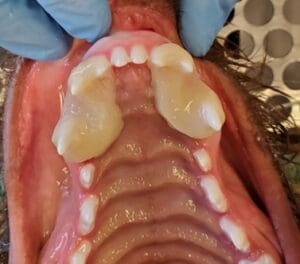
An orthodontic appliance (incline planes) on a patient being treated for linguoverted mandibular canines
In an adult dog, base narrow canines can cause even more damage. The adult canine teeth are so large that they can puncture through the bone and into the nose and/or they can destroy the bone supporting the upper teeth. One treatment option for a young adult dog is to move the teeth into the correct position. This can be done by either fabricating an orthodontic appliance (incline plane) or putting temporary crown extensions on the lower canines. Once the teeth have moved, they will be held in place by the upper jaw so that a retainer is not needed.
Another option is to reduce the height of the lower canines so that they no longer touch the palate. This is called crown reduction and vital pulp treatment. The tooth is measured and then cut. A small amount of pulp is removed, and a substance called MTA is placed to keep the pulp alive. The MTA is covered by a hard filling material. For this treatment, it is very important to have follow-up imaging performed in the future to verify that the treatment was successful.
Underbite
Some dogs are bred to have an underbite (class III malocclusion) and it is considered normal for breeds such as Boxers and French bulldogs. Although these dogs are bred to look a certain way, this malocclusion can cause problems due to teeth in either jaw contacting the opposite jaw’s soft tissue or teeth. All dogs with malocclusions should be evaluated because early treatment can prevent worse problems down the road.
Overbite
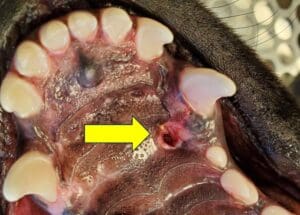
Palatal trauma secondary to a class II malocclusion (overbite). The trauma healed completely after treatment.
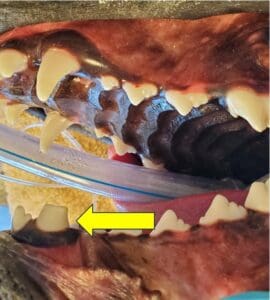
The same patient after crown reduction and vital pulp treatment of the tooth that was contacting the palate
Having an overbite, or class II malocclusion, is not normal or desirable for any dog or cat. In this malocclusion, the lower jaw is shorter than the upper. The lower canines are almost always contacting the palate. Orthodontic movement may not be an option, but in general, the treatment is the same as for base narrow canines.
Cats are different in that their canine teeth are relatively much larger and sharper than dogs and their face is flatter. Most cats with a class II malocclusion already have significant damage to the tissue of the upper jaw necessitating extraction of the upper canines. In many cases, this can create space for the lower canines so that they don’t cause any further pain.
Treating Malocclusion in Fort Collins Pets
Whether you have a kitten or a puppy, it’s important to have the occlusion checked as the animal grows. If the malocclusion is mild, it may resolve without treatment. If you think that your pet might need help from a board-certified veterinary dentist™, please give us a call!
- Variants in FtsJ RNA 2′-O-Methyltransferase 3 and Growth Hormone 1 are associated with small body size and a dental anomaly in dogs | PNAS
- Herrmann K, Taney K. Assessment of Extractions of Deciduous Mandibular Canine Teeth to Correct Linguoversion Malocclusion in 17 Dogs. J Vet Dent. 2022;39-(3):234-240.
Images used under creative commons license – commercial use (9/8/2023). Photo by Caleb Oquendo on Pexels